A founding member of OHADA, CEMAC and ECCAS, the Republic of the Congo (Brazzaville) combines civil-law national legislation, uniform OHADA law and CEMAC community law. Not to be confused with its neighbour, the Democratic Republic of the Congo, which belongs to partly different organizations.
Select an organization to see its members, or display overlaps with the Republic of the Congo. The map challenge offers six legal geography questions. The map is in French.
Constitutional Court, Supreme Court, Court of Auditors and Budgetary Discipline
Currency
CFA franc (XAF), issued by the BEAC
Regional organizations
6, including the AU and AfCFTA
The Republic of the Congo at the crossroads of regional organizations
A member of six organizations, the Republic of the Congo is subject to complementary legal regimes: uniform business law (OHADA), economic and monetary union (CEMAC), regional integration (ECCAS) and forest cooperation (COMIFAC).
OHADA
founding member (1993)
Organization for the Harmonization of Business Law in Africa
Learn more
Seat
Yaoundé (Permanent Secretariat) · 17 Member states
Regulatory approach
Uniform Acts directly applicable without transposition: companies, securities, debt recovery, insolvency, arbitration, general commercial law.
Effect in Congolese law
Supranationality: Uniform Acts apply notwithstanding any conflicting provision of domestic law, whether earlier or later (Treaty, art. 10).
Court
CCJA (Abidjan): court of cassation for the application of Uniform Acts, in place of the Supreme Court of the Congo.
Legal data stakes
Foundation of the LegOmnia database under construction: CCJA case law and Congolese decisions applying the Uniform Acts.
CEMAC
founding member (1994)
Central African Economic and Monetary Community
Learn more
Seat
Bangui (Commission) · 6 Member states
Regulatory approach
Directly applicable regulations and directives; customs union, regional financial market; CFA franc issued by the BEAC, headquartered in Yaoundé.
Effect in Congolese law
Primacy of community law: regulations apply without any national transposition measure.
Court
CEMAC Court of Justice (N'Djamena).
Legal data stakes
Community regulations, directives and decisions, notably in banking, financial and customs law.
ECCAS
founding member (1983)
Economic Community of Central African States
Learn more
Seat
Libreville · 11 Member states
Regulatory approach
Economic integration and a peace and security architecture; protocols and decisions to be implemented by member states.
Effect in Congolese law
Ratified instruments fall under the treaty regime (Constitution); their practical effect depends on national implementing measures.
Court
A community court is provided for in the texts.
Legal data stakes
Monitoring of community decisions and their national implementation.
AU
founding member of the OAU (1963)
African Union
Learn more
Seat
Addis Ababa · 55 Member states
Regulatory approach
Constitutive Act and continental conventions (human rights, cybersecurity, data protection), applicable after signature and ratification.
Effect in Congolese law
Ratified and published conventions prevail over statutes (Constitution), subject to reciprocity.
Court
African Court on Human and Peoples' Rights (Arusha), within the limits of the ratified protocols.
Legal data stakes
Reference for continental standards, notably on personal data protection.
AfCFTA
State party to the Agreement
African Continental Free Trade Area
Learn more
Seat
Accra (Secretariat) · 54 Member states
Regulatory approach
Framework agreement and protocols: goods, services, investment, competition, intellectual property, digital trade.
Effect in Congolese law
In case of conflict with a regional agreement, the Agreement prevails, except between states that have achieved deeper integration (art. 19).
Court
State-to-state dispute settlement mechanism modelled on the WTO.
Legal data stakes
Monitoring of trade commitments and national implementing texts.
COMIFAC
member state
Central African Forests Commission
Learn more
Seat
Yaoundé · 10 Member states
Regulatory approach
Coordination of forest and environmental policies in the Congo Basin between ten states.
Effect in Congolese law
Commitments subject to the general treaty regime (Constitution).
Court
No community court.
Legal data stakes
Forest and environmental texts harmonised across the Congo Basin.
Common pitfalls: the Republic of the Congo is not a member
COMESA : Common Market for Eastern and Southern Africa. A frequent confusion between the two Congos: the neighbouring DRC is a member, the Republic of the Congo is not.
WAEMU : West African Economic and Monetary Union. It also uses a CFA franc, but one issued by the BCEAO: the Republic of the Congo belongs to CEMAC and the BEAC.
SADC : Southern African Development Community, of which the neighbouring DRC is a member. The Republic of the Congo is not.
OHADA and CEMAC: how they fit together
The six CEMAC member states, including the Republic of the Congo, also belong to OHADA. Two bodies of community law therefore apply there at the same time, with distinct scopes but points of contact.
Complementarity
OHADA focuses on business law (companies, securities, debt recovery, insolvency, arbitration), while CEMAC covers monetary policy (BEAC), the customs union, the regional financial market and banking regulation (COBAC).
Coexistence and overlaps
In the six countries belonging to both organizations, overlaps can arise, for example between OHADA company law and the community rules governing credit institutions or the financial market.
Two reference courts
The CCJA (Abidjan) rules on the application of the Uniform Acts; the CEMAC Court of Justice (N'Djamena) rules on the interpretation and application of CEMAC community law.
Which norm prevails?
The Congolese legal order has five levels. OHADA law and CEMAC law hold a special place: directly applicable, they prevail even over a later statute.
Level 1 · supreme norm
Constitution
The Constitution, adopted by referendum in October 2015, sits at the top of the legal order.
What about case law? It does not appear in the pyramid, but it shows how each level applies in practice. That is precisely the body of law LegOmnia is working to structure and make accessible.
Test your knowledge
Two interactive exercises: resolve real conflicts between norms, then check what you know about the Republic of the Congo's regional integration.
The norms referee
Score : 0
Case 1/6
A CCJA judgment must be enforced in another state party. Can the national judge review its merits?
Which norm or court prevails?
Quiz: regional integration
Score : 0
Question 1/15
What is the capital of the Republic of the Congo?
Frequently asked questions about Congolese law
Does the Republic of the Congo use the same CFA franc as Senegal or Côte d'Ivoire?
No. The Republic of the Congo is a member of CEMAC, whose CFA franc (XAF) is issued by the Bank of Central African States (BEAC), headquartered in Yaoundé. Senegal and Côte d'Ivoire belong to WAEMU, whose CFA franc (XOF) is issued by the BCEAO. The two currencies have the same parity but are distinct.
Does OHADA law apply in the Republic of the Congo?
Yes. The Republic of the Congo is a founding member of OHADA, whose Treaty was signed in Port Louis in 1993. The Uniform Acts are directly applicable there without transposition, notwithstanding any conflicting provision of domestic law, whether earlier or later (OHADA Treaty, art. 10).
Which court rules in cassation on OHADA law?
The Common Court of Justice and Arbitration (CCJA), based in Abidjan. It rules in cassation on the application of the Uniform Acts, in place of the Supreme Court of the Congo (Treaty, art. 14), and its judgments are enforceable in all member states (art. 20).
What is the difference between the Republic of the Congo and the DRC?
They are two separate states on either side of the Congo River. The Republic of the Congo (Brazzaville) is a member of CEMAC and uses the Central African CFA franc; the Democratic Republic of the Congo (Kinshasa) is not a member of CEMAC, uses the Congolese franc and belongs to SADC, COMESA and the EAC. Both are members of OHADA and ECCAS.
Which regional organizations does the Republic of the Congo belong to?
The Republic of the Congo is a member of six organizations: the African Union, the AfCFTA, OHADA, CEMAC, ECCAS and COMIFAC. It is not a member of COMESA, SADC or WAEMU.
Where does LegOmnia stand on Congolese law?
This is one of our priority jurisdictions and its integration is under way. We are building coverage step by step: OHADA law, shared by the 17 member states, is the foundation, progressively enriched with texts and case law specific to Congolese law. People on the waitlist will be the first to hear about each new milestone. OmniScan can already be deployed there today to digitise and index legal document collections.
Congolese law, soon at your fingertips
Join the waitlist to be among the first to access LegOmnia legal research on the Republic of the Congo and the OHADA area.
Educational summary; it does not constitute legal advice. References: Constitution of the Republic of the Congo, OHADA Treaty (arts. 10, 14, 20), CEMAC Treaty, AfCFTA Agreement (art. 19). Memberships as of October 2026.

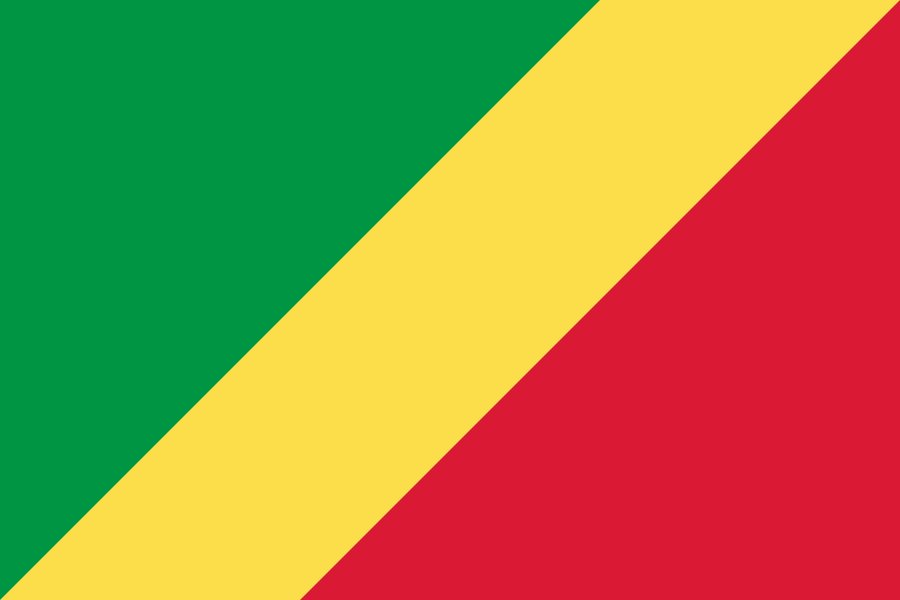 Jurisdiction · Central Africa